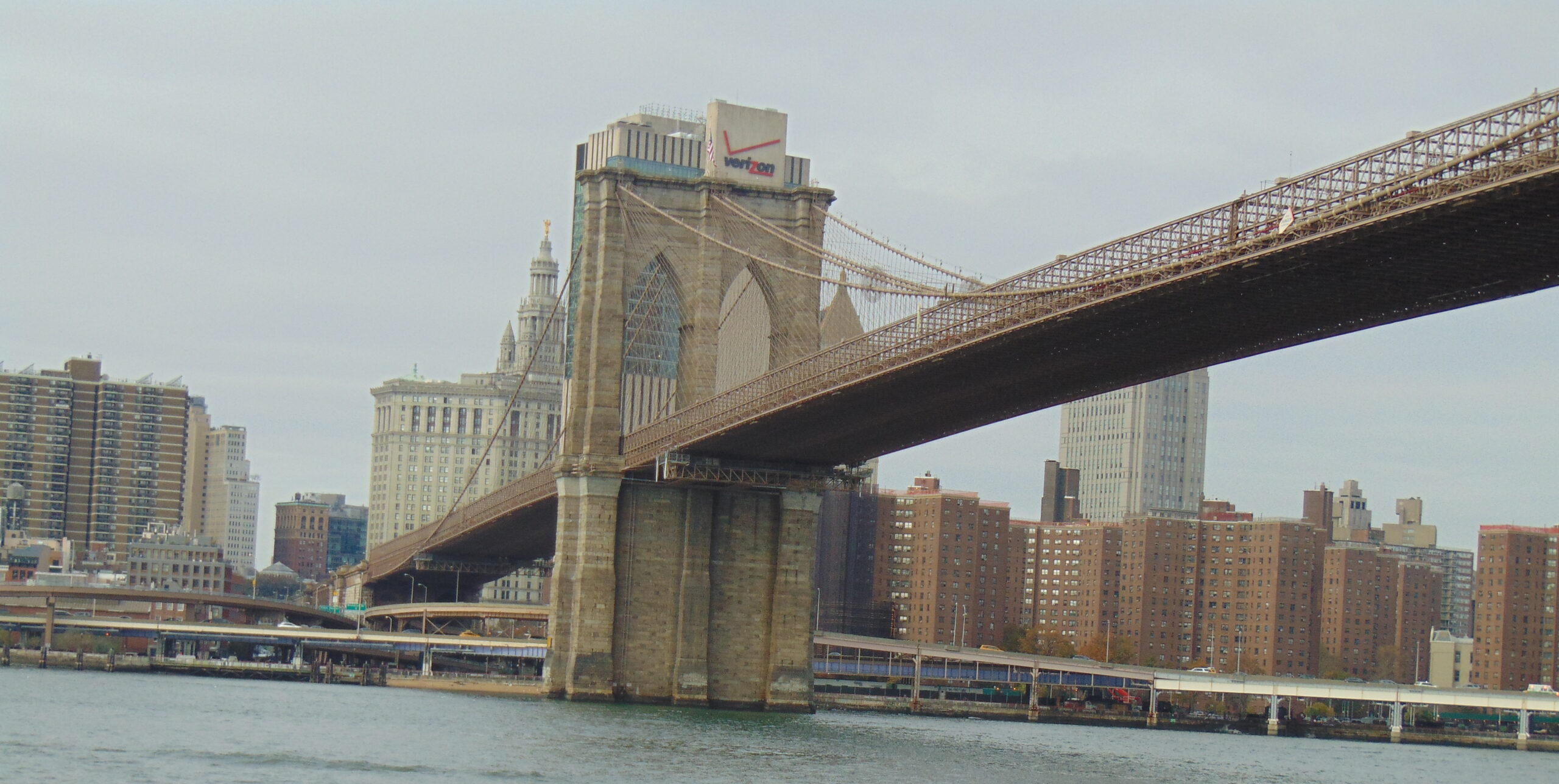
The Brooklyn Bridge, which is the world’s first steel-wire suspension bridge, connects Manhattan and Brooklyn over the East River. The Brooklyn Bridge was one of its kind for many years, serving as a tourist attraction then as well as now. It has had a significant impact on the socioeconomic status of New York City. Not only did it impact the economy of New York City, but it also contributed to its uniqueness. This bridge has changed the demographics of the Brooklyn-Manhattan communication systems.
Brooklyn is the largest borough of New York City and the most densely inhabited county in New York State. However, it is the most preferred place to live for New Yorkers due to its comfortable housing, vibrant yet calm lifestyle, and available commodities. Thanks to the Brooklyn Bridge, the face of Brooklyn has changed from about 150 years ago when it was nothing more than a mere cow town. After the Brooklyn Bridge was built, the demographics of Brooklyn changed dramatically. Although Brooklyn and New York are separated by only a few miles, people used to have to take a ferry to cross the East River to get to Brooklyn and vice versa. The ferry ride was dangerous, and in winter, the ferry could barely move when the river water froze. It could take more than an hour to get across. Essentially, Brooklyn was isolated from the mainland of New York, and the ferry was the only means of interconnection. Things began to change in 1852 when commuters finally decided to do something about it. A bridge was a possible solution to that problem.
Enter John Augustus Roebling, a pioneering civil engineer who resolved to make the dream of the Brooklyn Bridge possible. Roebling was born in Germany. After graduating, he immigrated to the United States to pursue a career in engineering. Roebling became one of the leading suspension bridge builders in the U.S. McCullough wrote about the plan:
“They met at his request on at least six different occasions, beginning in February 1869. With everyone present, there were just nine in all—the seven distinguished consultants he had selected; his oldest son, Colonel Washington Roebling, who kept the minutes; and himself, the intense, enigmatic John Augustus Roebling, the wealthy wire rope manufacturer of Trenton, New Jersey, and builder of unprecedented suspension bridges”.
Roebling began building the bridge in 1869 after the discussion. Because of his professional skill and depth of knowledge, he was the perfect fit. Unfortunately, he did not live to complete the structure he designed. While working on the project, he met with a ferry accident that led to his death. After his demise, his son, Washington Roebling, began to work on his plan. It took 14 years until misfortune followed the Roebling family, as Washington faced the bends and became paralyzed, making his presence at the construction site impossible. From then on, his wife, Emily, took over. She started to oversee the creation of the bridge as Washington watched her from the window of his house. It was Emily who finally finished building the enormous conduit in 1883. And this sacrifice was worth it. This architectural wonder first opened to people in the same year, and trade across the East River sprang to life.
Building a gigantic infrastructure like the Brooklyn Bridge demanded deep engineering knowledge, as John Augustus Roebling had. He knew his craft, and his plan was solid. However, despite his qualifications, there were many rumors and judgments about the bridge. Some suspected that the bridge could not be built, and some said it would shake too much, but the existence of the bridge proved them wrong. A project like the Brooklyn Bridge is a truly fascinating event, and people cannot be blamed if they did not think it could be built in reality, as no such architecture had been built before it. Stretching to about 1.1 miles, it was also the second-highest infrastructure of its time. Roebling was a master of suspension bridges and wire connections. Washington, who was also a civil engineer, fit into his father’s shoes perfectly after his death. Building this bridge was not easy. It was highly dangerous to work on its construction. “They wanted men to work underwater in the iron caissons of the Brooklyn Bridge, and they were paying from five to ten dollars a day… but the danger, if danger there was, appealed to me almost as much as the big pay…”. People worked there because the pay was good at that time, regardless of the risks involved.
Roebling used groundbreaking techniques to build the bridge. He erected two gigantic towers with a nomadic caisson method, connected the towers with steel wires, and anchored the wires to the ground to prevent the towers from leaning inwards. Caissons are large wooden boxes that served as the foundation for the towers. They were submerged in the water in an upside-down manner, and when they hit the soil under the river, the workers entered them through holes on top. The caissons were then filled with compressed air, creating an airlock to prevent the entry of water. Those workers were known as “sand hogs”. They dug out the mud from under the river until they reached solid bedrock. Then the workers exited, and the caissons were filled with concrete. The caissons remained underwater as the foundation for the towers. They were wrapped with iron sheets to protect them from water. The process was necessary to build a strong foundation, but it caused many people to contract a disease called the Bends or Caissons disease due to the airlock system causing an imbalance in blood gases. The engineer Winston Roebling himself suffered from this and was crippled for life.
Despite its death toll, this bridge became a matter of pride as it was the longest suspension bridge of its time. The bridge has a center span of 1,595.5 ft and side span of 933 ft. A gigantic project that can be seen from far and near; the more closely it is observed, the greater its magnificence becomes. The Brooklyn Bridge made New York City the most valuable commercial metropolis in the United States. By connecting Manhattan and Brooklyn, this bridge helped transform Brooklyn from an individual city into a borough of New York City. It helped increase Brooklyn’s population, as it allowed people to live in Brooklyn and commute quickly to jobs in the rest of New York City.
It was the first example of how profoundly a suspension bridge could impact the lives of New Yorkers. The bridge is an example of human effort and ability. It not only uplifted the socio-economic condition of the people of Brooklyn but also brought them comfort, a safe passage to roam, and became a site of tourist attraction. The bridge helped flourish Brooklyn and its people. They could live in Brooklyn yet work in Manhattan effortlessly because of this bridge. This bridge is proof of the strength of the human spirit, the possibility of invention that arises from human needs, and a milestone in the development of human civilization.